Next Day Delivery for just £15.00
Article
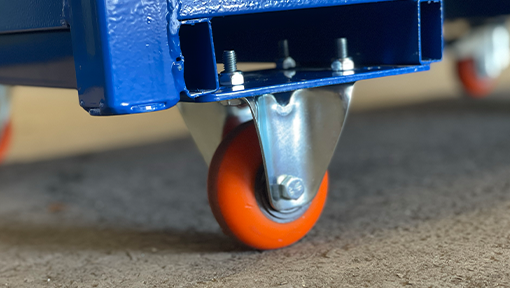
Use this page to quickly match wheel material to your operating temperature and speed of movement.
For towing, higher speeds, extreme heat or unusual chemicals, you can contact Coldene for application-specific guidance.
Note: The table scrolls both up and down and left and right
| Material | Continuous temperature | Intermittent temperature | Typical speed rating | Best for | Key notes |
|---|---|---|---|---|---|
| Polyurethane (Standard) | -40°C to +82°C | N/A | 2 to 4 km/h (walking speed) | General industrial, warehousing, manufacturing, food processing | Excellent floor protection, chemical resistant, non?marking, good oil and solvent resistance |
| Polyurethane (Ergonomic / High?Performance) | -40°C to +82°C | N/A | 2 to 4 km/h manual (towing possible) | Material handling, trolleys, carts, AGVs, tuggers | Low rolling resistance, reduced push and pull force, energy?returning formulations available |
| Nylon (Standard) | -20°C to +80°C | N/A | 2 to 4 km/h (walking speed) | Light to medium duty industrial equipment | High load capacity, low rolling resistance, resistant to oils, fats and alkalis, avoid concentrated acids |
| Glass?Filled Nylon (High Temperature) | -30°C to +177°C | Up to +230°C (short periods) | 2 to 4 km/h (walking speed) | Bakery ovens, autoclaves, commercial baking, smokehouses | Suitable for moist heat, not suitable for dry heat (risk of shattering when moisture reaches zero), non?marking |
| Rubber (Standard) | -45°C to +71°C | Up to +82°C (short periods) | 2 to 4 km/h (walking speed) | Floor protection, shock absorption, quieter movement | Non?marking, shock absorbing, can become brittle in outdoor or extreme cold |
| High?Temperature Elastomeric Rubber | -45°C to +232°C | Up to +246°C (short periods) | Towing possible (consult) | Sterilisers, autoclaves, bakery, continuous use | Bonded to cast iron core, resists cracking and chunking, quiet operation, excellent for towing |
| Cast Iron | -30°C to +200°C (with standard bearings) | Up to +316°C (with high?temp bearings and grease) | N/A | Heavy duty industrial, high heat, rough surfaces | Very durable, high load capacity, noisy and heavy, marks floors, performance depends on bearings |
| Phenolic Resin (Standard) | -45°C to +121°C | N/A | 2 to 3 km/h (slow walking speed) | Light to medium duty industrial, warehousing | Chemical resistant (oils, grease, petrol), economical, not recommended for submerged or constantly wet environments |
| Phenolic Resin (High Temperature) | -45°C to +232°C | Up to +246°C (short periods) | 2 to 3 km/h (slow speed) | Powder coating ovens, curing ovens, dry?heat bakery ovens | Best for dry heat, brittle compared to other materials, not recommended for wet environments or towing |
| Forged Steel / Steel | -40°C to +316°C | Above +316°C (consult) | Variable (application dependent) | Foundries, heat treatment, heavy manufacturing, extreme loads | Highest strength, excellent shock loading resistance, load capacity may decrease above +316°C |
Most speed ratings shown are for manual propulsion at walking speed (2 to 4 km/h). Higher speeds can be possible for specific towing setups. Contact Coldene’s engineering team for towing or high-speed requirements.
Actual performance depends on:
Load capacities can drop significantly as temperatures rise. Always verify capacity at your operating temperature.
High-temperature applications require regular re-greasing with appropriate high-temperature lubricants. Frequency depends on temperature and duty cycle.
Sometimes. The table shows typical manual speeds. Towing speed depends on wheel material, load, core, bearings, lubrication, and duty cycle. Contact Coldene with your target speed, load per wheel, and temperature.
Continuous is the expected sustained operating temperature. Intermittent is short exposure at higher temperature. Intermittent capability does not mean the wheel can run continuously at that peak.
It is designed for moist heat environments. In dry heat, the material can become brittle and may shatter when moisture content reaches zero.
Materials like cast iron and steel can mark floors and are noisier. Polyurethane and rubber are typically better for floor protection.
Often, yes. Above typical bearing temperature limits, you may need specialised bearing types and high-temperature grease. Bearing choice can be the limiting factor, not the wheel material.
For technical support and custom specifications
Phone: +44(0)1296 431135
Email: sales@coldene.com
Web: www.coldene.com
If you have a question around a product, or just a general query. Call us on 01296 431135, or submit the form below.
Receive 10% off of your first order with Coldene, use code WELCOME10