Next Day Delivery for just £15.00
Article
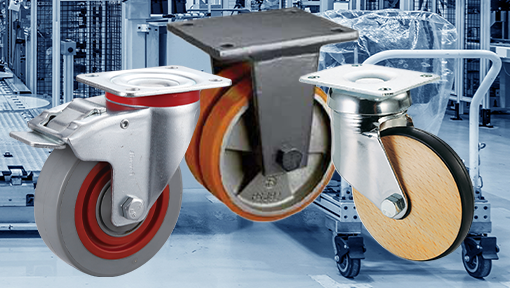
Castor wheels enable equipment to move across floors safely and efficiently. The three core types – swivel castors, fixed castors and braked castors – control direction, maintain stability and prevent unwanted movement.
Selecting the wrong type creates immediate problems such as floor damage, injury and a lack of control.
We’ve engineered castor solutions for NASA, BAE Systems, and Jaguar Land Rover for over 15 years, and the pattern is consistent: matching castor type to load, floor surface, and movement requirements eliminates these issues.
A castor comprises a wheel, fork, mounting point and optional swivel head or brake mechanism.
The fundamental choice between swivel, fixed, and braked configurations is dictated by how you need the equipment to move and when it needs to be stationary.
Swivel castors rotate 360 degrees, allowing equipment to pivot within its footprint and navigate tight spaces.
You may notice these being used to allow medical trolleys to navigate tight turns in treatment rooms and between ward equipment, to reposition office chairs without lifting, and to move retail displays freely in crowded stockrooms.
The bearing-mounted swivel head automatically aligns with any direction of travel – operators simply push, and the castor follows.
Swivel castors excel when:
The trade-off is reduced straight-line stability. Equipment with four swivel castors can wander at speed or over long distances as wheels suddenly rotate on uneven floors.
This makes all-swivel configurations unsuitable for platform trucks moving loads across warehouse distances – they’re designed for tight-space manoeuvrability, not tracking control.
Fixed castors roll only forwards and backwards with no swivel mechanism, providing superior tracking stability for heavy loads and predictable movement over distance.
Platform trucks transporting parts for major airline manufacturers maintain precise headings without operator correction. Manufacturing dollies moving engine assemblies for global car manufacturers track straight under loads exceeding 2,000kg per castor.
Fixed castors are essential when:
Fixed castors cannot turn, making equipment impossible to manoeuvre in tight spaces. A trolley with four fixed castors moves only forwards and backwards; changing direction requires lifting the entire assembly. This explains why most equipment uses combination configurations rather than fixed-only setups.
Braked castors incorporate mechanisms that prevent wheel rotation, swivel head movement, or both. These safety features are mandatory wherever equipment must remain fixed during loading, patient transfers or operator access – unexpected movement creates injury risk.
Three brake system types:
Hospital beds, medical trolleys, access platforms, mobile racking and catering equipment on slopes all require braked castors. In corrosive environments like commercial kitchens, specify high-performance stainless steel castors with sealed brake components to prevent rust-related failures.
Most equipment uses combinations of these types to balance manoeuvrability, stability and safety.
| Type | Key Benefit | Load Range | Best For | Watch Out For |
| Swivel | 360° rotation, tight turns | 50-800kg | Medical trolleys, office chairs, retail displays | Wanders at speed or distance |
| Fixed | Straight tracking | 200-5,000kg | Platform trucks, dollies, predictable routes | Cannot turn without lifting |
| Braked Swivel | Manoeuvrability and locking | 75-1,000kg | Hospital beds, workstations | Higher cost, needs maintenance |
| Braked Fixed | Tracking and locking | 300-2,500kg | Slopes, loading docks, staging | No directional flexibility |
Wheel material determines rolling effort, floor damage risk and noise levels for swivel castors, fixed castors and braked castors alike. Selecting the wrong material undermines any castor configuration – hard wheels mark delicate floors while soft wheels make heavy trolleys difficult to move.
Most equipment combines castor types rather than using one type exclusively. Two proven configurations solve the majority of applications:
Provides straight-line control from fixed castors, while swivel castors enable steering. Fixed castors should be 10-25mm larger in diameter to handle the majority of the weight during forward movement. Ideal for platform trucks, warehouse trolleys, catering equipment and industrial dollies moving over distance. Cannot pivot on the spot but offers stable, controllable handling at a lower cost than all-swivel configurations.
Maximum manoeuvrability for tight spaces with comprehensive locking capability. Equipment pivots within its footprint and locks securely from any position. Requires higher-quality swivel castors with precision bearings to prevent wobble under load. Ideal for medical equipment, mobile workstations and retail displays requiring frequent repositioning. More expensive than mixed configurations and can wander at speed.
Never mix different wheel materials on the same equipment unless specifically designed for it. Nylon wheels roll more easily than rubber wheels, so a trolley with mixed materials will rotate toward the higher-resistance side during movement, leading to unpredictable handling. Maintain consistent wheel specifications across all castor positions.
Heavy-duty fabricated castors with welded fork construction handle loads exceeding 1,500kg per castor – essential for aerospace and automotive manufacturing, where pressed steel castors fail under extreme weight.
Fixed castors provide 20 to 40% more load capacity than equivalent swivel castors due to rigid mounting that eliminates side-loading stresses. Pair these with nylon wheels for maximum load capacity and specify a 2× safety factor minimum to account for impact forces when cranes place engine assemblies onto trolleys.
For Ford and Caterpillar production lines, we supply fabricated castors with 200mm+ diameter nylon wheels handling loads up to 3,000kg per castor.
Most trolleys perform best with two fixed rear castors and two swivel front castors. This configuration combines straight-line tracking stability from fixed castors with steering control from swivel castors at the front, where operators push.
Use four swivel castors only when operating in confined spaces that require 180-degree turns within 240cm, such as hospital corridors or retail stockrooms. Reserve all fixed configurations exclusively for straight-line movement between fixed locations, such as warehouse loading docks, where equipment never needs to turn.
The fixed rear castors should be 10-25mm larger in diameter to handle the majority of the weight during forward movement.
Solid rubber wheels provide superior floor protection for polished hardwood, vinyl, and linoleum due to their soft contact surface, which distributes load over a larger area and absorbs shock.
This makes rubber ideal for swivel castors on hospital beds and office chairs where floor marking is unacceptable. However, rubber wheels require 40% more force to move equipment than nylon wheels do, making them unsuitable for heavy trolleys or frequent movement.
Polyurethane wheels offer the best compromise, delivering significantly better floor protection than nylon while maintaining low rolling resistance suitable for mixed environments. We specify polyurethane for combination setups using swivel castors at the front and fixed castors at the rear, where both floor protection and efficiency matter.
Specify stainless steel castors for any environment with water exposure, chemical exposure, food contact, or hygiene requirements, where standard steel castors corrode and contaminate products.
Commercial kitchens require stainless steel swivel castors with total lock brakes on catering trolleys to prevent rust during daily washdown.
Pharmaceutical clean rooms, medical facilities and coastal outdoor installations all demand stainless steel construction with sealed bearings.
Marine applications and food processing environments benefit from pairing stainless steel castor bodies with polyurethane wheels for complete corrosion resistance.
While stainless steel costs more initially, it eliminates replacement cycles and maintains hygiene standards throughout the product’s service life.
If you would like guidance on selecting the right castor for your equipment or have a specific application that needs a tailored solution, our team is ready to help. Contact us for expert advice on load requirements, wheel materials, bracket construction, and environmental considerations. We are always happy to recommend the most suitable castor for your project.
If you have a question around a product, or just a general query. Call us on 01296 431135, or submit the form below.
Receive 10% off of your first order with Coldene, use code WELCOME10