Next Day Delivery for just £15.00
Article
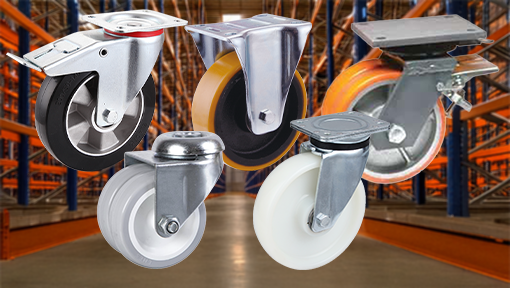
Choosing the right castor is essential for mobility, safety, and durability in industrial, commercial, and office environments. Castors vary in load capacity, wheel material, and bracket construction. Understanding the differences between light, standard, medium, heavy duty, and fabricated castors ensures your equipment moves efficiently and reliably.
Light duty castors are ideal for applications with minimal weight and high manoeuvrability.
Light duty castors are cost-effective, easy to install, and suitable for smooth, even floors. They are not suitable for heavy loads or rough surfaces.
Shop for Light Duty Castors Here

Medium duty castors are designed for robust use, carrying heavier loads over uneven surfaces.
Medium duty castors offer enhanced strength and durability for frequent use in demanding environments.
Shop for Medium Duty Castors Here

Heavy duty castors are built for very high loads and intensive industrial use.
These castors are engineered for maximum load-bearing, impact resistance, and long service life.
Shop for Heavy Duty Castors Here

Fabricated castors are custom-built for extreme or specialised applications.
Fabricated castors offer maximum durability and can be tailored to meet unique operational requirements.
Shop for Fabricated Castors Here

When selecting castors, consider:
FAQ: Choosing Castors
Q: What is the difference between medium and heavy duty castors?
Medium duty castors handle up to 400kg per castor and are suitable for industrial trolleys, while heavy duty castors carry several tonnes and feature reinforced brackets and bearings for extreme loads.
Q: Which castor type is best for industrial machinery?
Heavy duty or fabricated castors are ideal for machinery, depending on load, environmental conditions, and floor type.
Q: Are light duty castors suitable for office trolleys?
Yes, light duty castors are perfect for low-weight office furniture and small trolleys on smooth floors.
| Castor Type | Load Capacity per Castor | Wheel Materials | Bracket / Assembly Construction | Typical Uses |
|---|---|---|---|---|
| Light Duty | Up to 120kg | Plastic, nylon, soft rubber | Pressed steel or moulded plastic; simple top plate or bolt-hole; basic swivel bearings | Office chairs, small trolleys, light display units |
| Standard Duty | 70–400kg | Nylon, polyurethane, rubber, light metal | Stamped or pressed steel with reinforced plates; ball or roller bearing swivel; top plate or bolt-hole mounting | Service trolleys, retail displays, light equipment transport |
| Medium Duty | 100–400kg | Reinforced polyurethane, heavy-duty rubber, steel | Pressed or welded steel with gussets; precision ball or roller bearings; thicker top plates; optional brakes/directional locks | Industrial trolleys, hospital beds, manufacturing equipment |
| Heavy Duty | 300kg–several tonnes | Cast iron, steel, reinforced polyurethane | Heavy-gauge welded or forged steel; industrial roller or sealed bearings; thick top plates with gussets/ribbing; optional brakes/directional locks | Machinery, container trolleys, large industrial equipment |
| Fabricated | Medium to extremely heavy (custom) | Mild steel, stainless steel, engineered polymers | Fully welded or machined brackets; heavy-duty swivel assemblies with multiple bearings; bespoke plate, flange, or bolt-on mounting | Offshore or hazardous environments, large industrial trolleys, chemical plants, cleanrooms |
If you would like guidance on selecting the right castor for your equipment or have a specific application that needs a tailored solution, our team is ready to help. Contact us for expert advice on load requirements, wheel materials, bracket construction, and environmental considerations. We are always happy to recommend the most suitable castor for your project.
If you have a question around a product, or just a general query. Call us on 01296 431135, or submit the form below.
Receive 10% off of your first order with Coldene, use code WELCOME10