Next Day Delivery for just £15.00
Article
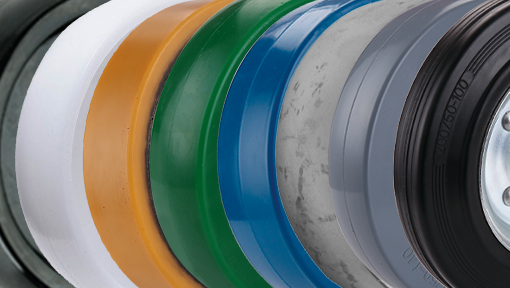
Choosing the right castor and castor wheel material is determined by load capacity, service life, chemical resistance and floor protection. Select material by matching your operating environment to material properties: load weight and distribution, floor surface type, temperature exposure, chemical contact, and duty cycle frequency.
Hard materials perform well on smooth hard surfaces. Soft materials are suitable for rough surfaces or outdoor use. Material hardness affects floor protection directly: harder wheels roll more easily but risk floor damage, while softer wheels protect floors but increase push effort.
Temperature and chemical exposure eliminate unsuitable materials before considering other factors.
Your equipment weight plus maximum load tells you which materials will work and which will fail early. Most engineers calculate average loads instead of real-world forces. This is a mistake. Load rarely spreads evenly across castors. Uneven floors cause rocking during loading. Bumpy surfaces shift weight between wheels. Some castors end up carrying far more weight than your calculations suggest. We design for worst-case scenarios in aerospace and heavy industrial work. Sometimes two castors have to support the entire load temporarily. Your material choice needs to handle this.
Duty cycle also makes a huge difference.
Continuous movement creates heat through repeated tread compression. This heat builds faster than it can escape. Materials degrade and lose their load-carrying capacity.
Equipment that moves occasionally gets time to cool between uses. This can double or triple service life compared to continuous operation.
Wheel hardness versus floor hardness determines whether you succeed or fail. Hard wheels on delicate floors create point loading that dents and scratches surfaces. Soft wheels on rough floors sink into gaps, making equipment nearly impossible to move.
We once made custom solutions for BBC studios after standard castors left permanent marks on expensive flooring. They had to refinish the entire surface. Your floor type matters more than you think.
Extreme temperature ranges knock out entire material groups immediately. Standard polyurethane and rubber break down outside of moderate temperatures. High-temperature materials cost more but become your only real option.
Chemical resistance requires precise matching. Different elastomers resist different chemical families:
Continuous contact with chemicals is completely different from occasional splash exposure. Manufacturing environments where castors roll through cutting fluids every day need materials made for that exact chemical. General-purpose compounds look fine during testing but would fail within months.
Washdown environments can also destroy standard castors quickly. They combine moisture, pressure, temperature changes, and cleaning chemicals:
Zinc-plated frames corrode completely within a year in these conditions. Stainless steel isn’t optional here; you can find suitable stainless steel options in our high-performance range.
What actually happens when a castor fails changes how you should think about material costs. This turns material selection from a purchasing decision into a risk decision.
Our ISO9001-certified processes and 12-point quality inspection are in place because our clients face serious problems when castors fail. Aerospace manufacturers, defence contractors, and medical device companies can’t tolerate material failures.
We design for applications where the right material prevents production shutdowns that cost thousands per hour. It stops safety incidents that hurt people. It avoids regulatory violations that can shut down operations.
A heavy plant machinery manufacturer searched for better castor solutions for over 14 years. Every castor manufacturer offered its own solution, but some lasted only a few weeks, while others weren’t competitively priced. The company remained stuck with a product that failed regularly because suppliers focused on matching load specifications rather than understanding the actual operating conditions.
We listened and understood their specific issues rather than immediately offering a standard solution. We designed and produced a product tailored to their actual operating environment, solving all their problems. The difference came from examining where the equipment operated, how it moved, and what conditions it faced, rather than treating load capacity as the only specification parameter.
Load capacity alone doesn’t determine castor performance. Floor type, duty cycle frequency, impact exposure, temperature ranges, and chemical contact all affect whether castors succeed or fail in service. Equipment carrying identical loads in different environments requires different specifications. Comprehensive specifications account for operating conditions rather than relying solely on theoretical load calculations.
An agricultural machinery manufacturer used the same castors for twenty years without problems. Recent product changes meant trailers now carried higher loads and worked faster to feed production lines. The existing castors couldn’t handle these new demands, compounded by extremely poor road conditions with potholes and drains everywhere the trailers operated.
We examined their old product and the environment, then totally redesigned and manufactured a more robust solution. We retained all key dimensions so the new castor bolted straight onto existing applications. The new design even reduced unit weight by 15kg, helping engineers when fitting the castors.
Castor specifications that worked reliably for years fail when operational parameters change. Higher loads combined with faster speeds and rougher surfaces create forces that the original specifications weren’t designed to handle.
You should review castor specifications when:
The original specifications assumed specific operating parameters – changing those parameters requires reassessing material and construction requirements.
A water filtration system supplier used ISO container castors from another company, which required the castors to be fitted directly underneath the container. This mounting configuration put their workforce at high risk during installation and maintenance. The specification met load capacity requirements but created unacceptable safety hazards.
We designed a side-locking mechanism that allowed safe castor installation without putting workers at risk beneath containers. The solution maintained the required load capacity while eliminating the safety hazard and ensuring employee protection.
Castor specifications that focus exclusively on load capacity and material type miss critical factors, including how castors will be installed, maintained, and replaced. If the mounting configuration requires workers to position themselves under heavy suspended loads, the specification creates safety violations regardless of adequate load capacity. Health and safety considerations should eliminate certain mounting approaches before evaluating materials or load ratings.
Container castors used to move very heavy loads often include a directional lock on swivelling versions. Users engage the locks to prevent the castors from rotating during transport, but often do so while the wheels are ahead of the swivel point, which creates extreme forces that can cause significant damage.
Offset swivel castors automatically align themselves into an optimal configuration when directional force is applied, so the wheel trails behind the castor swivel point. Engaging directional locks while wheels are positioned ahead of the swivel point blocks this self-correction process. The extreme forces generated when attempting to move the load dissipate through the locking mechanism and the castor assembly, exceeding their design parameters and causing damage to both the locking mechanism and the overall integrity of the assembly. This also creates a risk to the user’s health and safety, as well as to those around the load.
Inspect all swivel castors to ensure they’re properly oriented before engaging the directional locks. Each castor is marked with an arrow indicating optimal orientation. If castors aren’t oriented correctly, apply enough directional force to the load to encourage self-correction to their optimal orientation, then apply the directional locks. An optional steering bar is available which can orient the castors in any direction while the load is stationary.
Understanding how castor mechanisms work prevents damage from improper use. Directional locks provide valuable functionality, but engaging them incorrectly creates forces that exceed design limits and may invalidate the warranty. Failure to follow proper procedures may result in significant damage to the castor and the load, as well as risk to user health and safety.
Which Material Should You Choose?
| Material | Best For | Max Load Per Castor | Safe For Delicate Floors | Service Life | Temperature Range | Chemical Resistance |
| Grey Rubber | Hospitals, offices, retail | 150kg | Yes – vinyl, timber, tile | 1-2 years | Room temperature only | None |
| Polyurethane | Warehouses, factories | 500kg | Concrete and epoxy only | 4-5 years | -10°C to +40°C | Oils, water, standard chemicals |
| Nylon | Heavy industry | 1,500kg | Concrete only | 7-10 years | -40°C to +80°C | Oils, solvents, moisture |
| Phenolic | Bakeries, autoclaves | 800kg | Concrete only | 5-7 years | -40°C to +280°C | Extreme temperatures |
| Cast Iron | Foundries, extreme loads | 3,000kg | Concrete only | 10+ years | -40°C to +300°C | Everything |
Medical floors are damaged easily. Vinyl and polished timber show wheel marks immediately. Hospital administrators notice these marks, and complaints start flowing in.
Grey rubber solves this problem completely. We’ve supplied thousands of castors for hospital beds, medical trolleys, and imaging equipment where floor marking creates real headaches for facilities teams. The material also runs quietly, which matters enormously in patient care areas.
Medical environments clean equipment with disinfectants multiple times every day. Your castor materials need to handle this:
We make stainless steel castors specifically for medical applications where standard hardware fails quickly. For equipment that requires both corrosion resistance and adjustable height, see our stainless- steel height-adjustable castors.
A 180kg medical trolley needs roughly 90kg capacity per castor when you account for uneven loading. Grey rubber handles this easily while keeping vinyl floors pristine.
Concrete floors can handle harder wheels. Polyurethane protects the floor while rolling easily under continuous operation. Operators push heavy loads with far less effort compared to softer rubber.
We’ve supplied polyurethane castors for distribution centres running 24/7. The material resists most cleaning chemicals, handles oils, and doesn’t mark concrete or epoxy floors. Service life runs into years rather than months when loads stay within capacity.
A 600kg pallet dolly moving continuously needs at least 400kg capacity per castor. Polyurethane on a nylon or cast iron core delivers this capacity while still protecting floors. Clients running heavy equipment in automotive assembly plants specify these combinations because standard materials wear out too quickly under continuous heavy-duty conditions.
Bakery ovens run at 200-250°C. Standard materials melt catastrophically at these temperatures.
We make high-temperature castors rated from -40°C to +280°C for continuous use in food processing. Phenolic wheels withstand the constant temperature cycling in these environments. Going from ambient to extreme heat repeatedly destroys standard polyurethane or rubber within weeks.
One bakery client ran standard nylon wheels in their convection ovens. The wheels failed after three weeks. The phenolic wheels we supplied have been running for years.
Kitchen washdown areas need stainless steel hardware. Standard zinc-plated frames corrode rapidly under high-pressure cleaning and chemical sanitisers. Polyurethane wheels on stainless steel frames meet the washdown protocols required by food service.
Machine tooling carts carry extreme loads, and we have the perfect heavy-duty castors for this.
Usually, an 800kg assembly fixture on four castors needs 667kg capacity per castor when you account for uneven floors and impact loading.
Polyurethane on cast iron cores meets this capacity while resisting the oils and coolants found in machining environments. We’ve supplied these combinations to aerospace clients where castor failure can stop production lines and cost thousands per hour to stand idle.
Nylon works for even heavier loads where noise doesn’t matter. The material resists chemicals effectively and rolls easily under extreme weight. Manufacturing floors built from robust concrete can withstand the hardness of nylon.
Chairs scratch timber floors. Vinyl shows wheel marks immediately. Office managers call facilities teams. Facilities teams call suppliers looking for solutions.
Grey rubber stops these complaints entirely. The soft material protects delicate floors completely while running silently. A 150kg loaded office chair needs about 56kg capacity per castor. Grey rubber handles this easily.
We supply grey rubber castors for retail fixtures, office furniture, and light institutional equipment where floor appearance matters, and loads stay moderate.
Rough concrete, gravel, and debris quickly destroy hard wheels. Nylon wheels skip over obstacles and send shocks straight into equipment and operators.
Solid rubber, pneumatic or puncture-proof tyres absorb the impacts that outdoor environments throw at them. We make these wheels for construction trolleys, site equipment, and outdoor material handling, where shock absorption matters more than maximum load capacity.
A 400kg construction cart on rough ground needs substantial safety factors. Use a minimum of 3.0× to account for impacts and uneven terrain. Pneumatic tyres can spread these shock loads across a larger area, where rigid materials crack from impact.
We’ve spent over 20 years helping engineers specify materials for environments where failure creates serious consequences. Our clients include aerospace manufacturers, NHS trusts, food processing facilities, and defence contractors who cannot tolerate material failures.
Every castor we manufacture goes through our 12-point quality inspection. Our ISO9001-certified processes exist because our clients in the medical, aerospace, and heavy industrial sectors demand reliability.
Call +44(0)1296 431135 or email sales@coldene.com. Speak to an advisor who understands your environment and can prevent costly specification mistakes before they happen.
Our UK facility in Aylesbury designs and manufactures bespoke solutions when standard options fall short. We’ve created custom castors for Rolls-Royce, NASA, Ford, and Boeing because sometimes your application demands more than the catalogue specifications deliver.
If you have a question around a product, or just a general query. Call us on 01296 431135, or submit the form below.
Receive 10% off of your first order with Coldene, use code WELCOME10