Next Day Delivery for just £15.00
Article
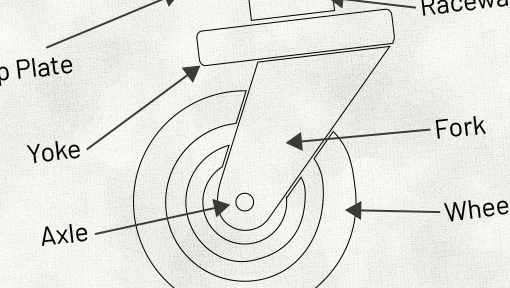
Welcome to our comprehensive guide on the caster industry, where you’ll find essential information and key definitions related to casters and their applications. Whether you’re new to the industry or looking to refresh your knowledge, this page provides a solid foundation for understanding the various types of casters, their components, and their specific uses across different sectors. From swivel casters to rigid models, and from load capacities to wheel materials, we cover the basics to help you navigate the world of casters with confidence.
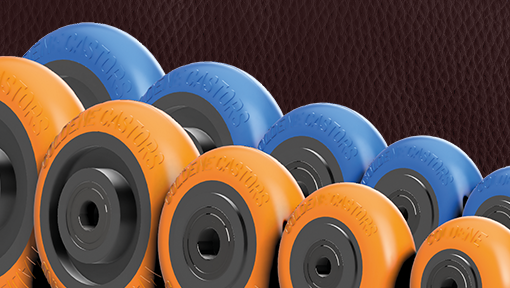
Wheels consist of a tyre or tread, a wheel centre or core, and a bearing. They differ in load capacity, rolling resistance, and rolling characteristics. The unique features of each wheel type are outlined in their respective section.

Swivel castors are designed to rotate around their vertical axis. This makes it easier to manoeuvre machinery, equipment, and other items they are attached to. The swivel head is connected to a fork assembly with the wheel axel located at a distance, horizontally from the swivel centre, creating an offset that allows the fork to swivel freely. This offset enables the castor to rotate smoothly and gives the castor a stable rolling characteristic while moving in a straight line. Swivel castors can be equipped with various brakes and locks to stop the castor from moving or rotating.

Rigid castors do not swivel and make moving machinery and equipment in a straight line easier without deviation.

A twin wheel is best when the application requires a low overall height and a high load capacity. The primary benefit of using a twin wheel is that it reduces swivel resistance. In the case of a single wheel, it remains in place while the castor rotates around it, leading to high friction and greater resistance. However, using a twin wheel, the wheels turn in opposite directions, and the castor rotates around them, significantly reducing ground friction and improving performance. Triple wheels are typically used where there is a need to accommodate very heavy loads

Wheel diameter is one of the most important factors affecting the wheel’s resistance. It is highly recommended to use a wheel with a diameter of 160mm or larger for loads that exceed 1,000kg to ensure safety when manoeuvring equipment. As a general rule, it is advisable to use larger wheel diameters for heavier loads.

The distance from the centre of the castor head fitting to the outside of the wheel is known as the swivel radius and is very important to ensure your castor does not foul on your application when rotating 360 degrees.

Swivel offset refers to the horizontal distance between a swivel castor’s vertical centerline and its wheel’s vertical centreline. The larger the offset, the easier it is to turn the castor under load. However, a larger offset also reduces the castor’s load capacity. Our engineers have designed offsets that balance good load-carrying capability and sufficient turning characteristics to optimise castor performance.

With decades of experience, our specialists are experts in advising and specifying top-quality castor solutions. Don’t hesitate to reach out and speak to an advisor today.
If you have a question around a product, or just a general query. Call us on 01296 431135, or submit the form below.
Receive 10% off of your first order with Coldene, use code WELCOME10