Next Day Delivery for just £15.00
Article
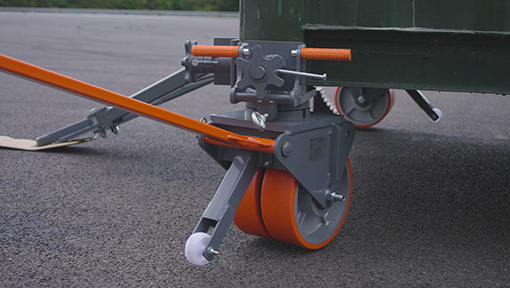
Container Castors are often used with very heavy loads. This necessitates careful castor setup and configuration, particularly when using the directional lock facility on the swivelling versions. Ensuring an optimal castor orientation is crucial before applying the direction lock feature.
Due to the nature of the construction of offset swivel castors, applying a directional force causes them to automatically align themselves into an optimal configuration, where the wheel trails behind the castor swivel point

If the castors’ starting position has the wheel oriented ahead of the castor swivel point, they will self-correct to their optimal configuration once the directional force is applied.

Engaging the directional locks while the wheels are positioned in front of the swivel point and then applying a directional force can lead to significant damage to both the locking mechanism and the overall integrity of the assembly. This damage occurs because the blocking of the of the self-correction process by the locking mechanism generates extreme forces that are dissipated through the locking mechanism and the caster assembly beyond their design parameters.
It is highly recommended that the user inspect all the swivel castors to ensure they are oriented optimally before engaging the directional locks. Each castor is marked with an arrow indicating the optimal orientation to engage the directional locks.

If the castors are not oriented optimally, apply enough directional force to the load to encourage them to self-correct to their optimal orientation, and then apply the directional locks. An optional steering bar is available, which can orient the castors in any direction while the load is stationary.
Ensuring the castors are oriented in their optimal configuration before engaging the directional locks is essential. Failure to do so may result in significant damage to the castor and the load, as well as a risk to the health and safety of the user and those around the load. Failure to follow this advice will also likely invalidate the warranty.
If you have a question around a product, or just a general query. Call us on 01296 431135, or submit the form below.
Receive 10% off of your first order with Coldene, use code WELCOME10