Next Day Delivery for just £15.00
Article
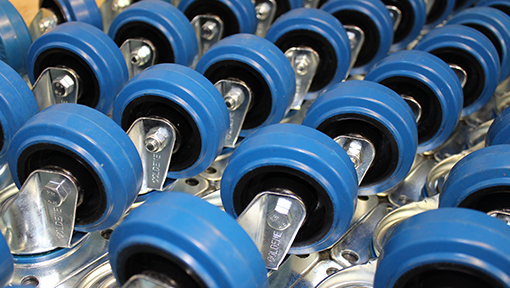
Various factors must be considered when planning to purchase castors. Different applications have unique castor requirements, so evaluating the entire environment and requirements is crucial to choosing the ideal castor for each situation.
It’s essential to keep in mind that castors are used in a specific environment for a particular application. The application will likely be hand-held or tugged, so the environmental conditions will significantly impact which castor is suitable. Therefore, it’s essential to consider a number of factors when selecting a castor for an environment.
There are two main ways to attach castors to your application: plate-mount or bolt-hole-mount.
If you have a heavy-duty industrial facility, plate-mount castors are the only option, as they are much more substantial. These castors connect to the bottom of the application using a flat plate. However, you must ensure you get the correct plate size for your specific application, as they come in a few different sizes.
When you are looking to buy swivel castors, you might come across the terms kingpin and kingpinless. Swivel castors are known for their ability to rotate 360 degrees, which means they can move in any direction. To facilitate this, most of them can be grouped into two categories: kingpin and kingpinless.
Kingpin castors are a type of swivel castors that utilise a kingpin assembly to achieve a full 360-degree range of rotation. This assembly includes an upper race with ball bearings and a bottom race with ball bearings, held together by a central vertically aligned pin. The pin-based assembly allows for smooth and effortless movement, making kingpin castors a popular choice in many applications.
Kingpinless castors lack the central kingpin. They provide the full 360-degree range of rotation by utilising ball bearings fitted in an upper and bottom race that interlock.
With Kingpin castors, the central pin holds everything together; in some applications, this may become loose and cause the castor to fail; kingpin castors can be adjusted by tightening or loosening the bolt that holds the two races together. kingpinless castors cannot be adjusted in this way.
Kingpinless castors are less prone to failure than kingpin castors. The latter often fails due to the kingpin assembly, leading to fluttering or shimmying of the wheels. These are more suitable for carrying heavier objects than kingpin castors. They also require less maintenance than kingpin castors. As there is no central pin, they do not need to be constantly adjusted. This means they can be used for many years without requiring much attention.
These are specifically designed for use in applications featuring a pre-drilled hole. They are mounted using a bolt that easily inserts into the bottom of your cart, trolley, or similar application. Castors using a single bolt-hole mounting are limited to 500kg and are widely used in different industries, including medical, food-processing, and DIY applications.
When choosing castors, the wheel size, tread, material, and other factors should be considered carefully as they significantly affect ride, resistance, and durability.
When selecting a castor, it is essential to consider the wheel’s size. Generally, there are specific demands for the size of the castor. This may be due to an existing application or a specific design requiring a castor of a particular height and diameter.
If you are starting to design an application, it is crucial to consider storage and other space restrictions where it will be used. When selecting castors, remember that larger-diameter castors generally roll more easily and can hold more weight, even more so the wider they are. Therefore, opt for larger diameter and broader castors if you need to prioritise ease of use and weight capacity.
When choosing the material for a wheel, there is no one-size-fits-all solution. The type of floor, climate, environment and application should all be considered to determine the best material for the wheel. In most industrial applications, using polyurethane or nylon wheels is the norm, but we always advise that you assess the situation thoroughly before making any decisions. The quality of the castor is also a significant consideration, as quality can vary greatly. For example, not all polyurethane wheels are the same – some may have better rebound resilience and durability than others. So, it is crucial to choose a wheel that suits the specific needs of your application.
To ensure that your castor wheel works well in your environment, you need to choose the right tread. There are two main types of tread: ergonomic (round profile) and flat/slightly crowned. An Ergonomic tread is excellent for reducing noise, providing cushion, and preventing debris. If you have the right amount of weight on the wheel, it can be beneficial for ergonomics. On the other hand, flat or slightly crowned castor wheels can handle more weight since there is less compression.
There are various types of wheel bearings available, but two or three types are usually sufficient for most applications. Precision ball bearings are usually preferred over caged roller bearings. They are more durable and can withstand most applications, including heavy loads in applications such as towlines.
Once you’ve reviewed your requirements, explore our specialist castor ranges to find the ideal solution for your application, here are some of our most versatile:
Low Level Castors:
Low level castors are designed for applications where overall height is restricted but strength and stability are key.
Standard/ Medium Duty Castors:
Standard duty castors The go-to option for everyday use, providing dependable performance for general equipment and trolleys.
Heavy Duty Castors:
Heavy duty castors engineered for high-load industrial environments where durability and reliability are critical.
High Performance Stainless Steel Castors:
Stainless steel castors are Ideal for hygiene-sensitive or corrosive settings such as food processing and medical applications.
Each type is built to the highest Coldene standards, ensuring smooth operation, long service life, and dependable performance under pressure.
Before you purchase your castors, be sure to consider all these questions.
What kind of equipment will you be moving with them?
How often will you be using them?
The kind of environment they’ll be used in
How far will the equipment be moved?
How much space do you have?
What sort of weight will you be moving?
What surface will the castors be used on?
What environment will the castors be used in?
Will they be used in high or low temperatures?
Will they be used in a toxic environment?
What kind of mounting will you need?
Do you need swivel or fixed castors?
Will the castors need brakes?
Do you need to consider anti-static castors?
How will the equipment be moved?
Will they be towed, and at what speed?
If you need help selecting the correct castor, we are happy to share our 25 years of experience in the industry. We have worked with thousands of customers, from individuals to multinational corporations, and can assist you in choosing the castor that best suits your needs. Our engineers can work with you to design a bespoke solution for your unique situation. Feel free to reach out to us anytime if you need help.
If you have a question around a product, or just a general query. Call us on 01296 431135, or submit the form below.
Receive 10% off of your first order with Coldene, use code WELCOME10