Next Day Delivery for just £15.00
Article
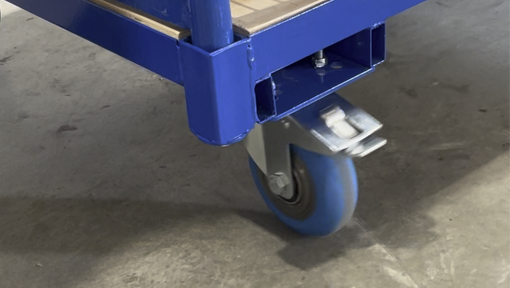
Swivel castors typically have a wheel that sits ahead of the swivel assemblies, creating a gap between the two points. The term’ swivel lead’ simply refers to the distance between the castor wheel and the swivel assembly.
Most swivel castors consist of a fork, axle, and a swivel assembly at the top of the castor. The swivel assembly connects to the fork, and the axle runs through the fork’s two prongs. However, not all swivel castors have straight forks. Some forks may project forward at an angle, causing the centre of the swivel assembly to be offset from the centre of the axle.

When selecting castors, it’s important to choose ones with a swivel lead that minimises castor flutter. Castor wheel flutter is a phenomenon whereby a castor wheel attached to a piece of equipment, such as a trolley, shakes or rotates uncontrollably from side to side, interfering with the ability to roll the equipment, especially at higher speeds. Castor wheel flutter is caused by harmonic excitation of the castor wheel. Affecting mainly rubber and polyurethane castors, the wheel tread deforms and rebounds due to force and movement, which leads to oscillations. Increasing the swivel lead increases the natural oscillation frequency of the wheel. The higher the frequency, the quicker the wheel must spin in order to flutter.
It’s important to note that castors with a high swivel lead often have a lower load rating than those with a low swivel lead. This means they may not be suitable for supporting heavy weight. In contrast, castors with a straight fork tend to have higher load ratings, making them a better choice for heavy loads. However, for applications where weight is not a concern, castors with a high swivel lead may be a more suitable option.
With decades of experience, our specialists are experts in advising and specifying top-quality castor solutions, including low level castors and heavy duty castors. Don’t hesitate to reach out and speak to an advisor today.
If you have a question around a product, or just a general query. Call us on 01296 431135, or submit the form below.
Receive 10% off of your first order with Coldene, use code WELCOME10